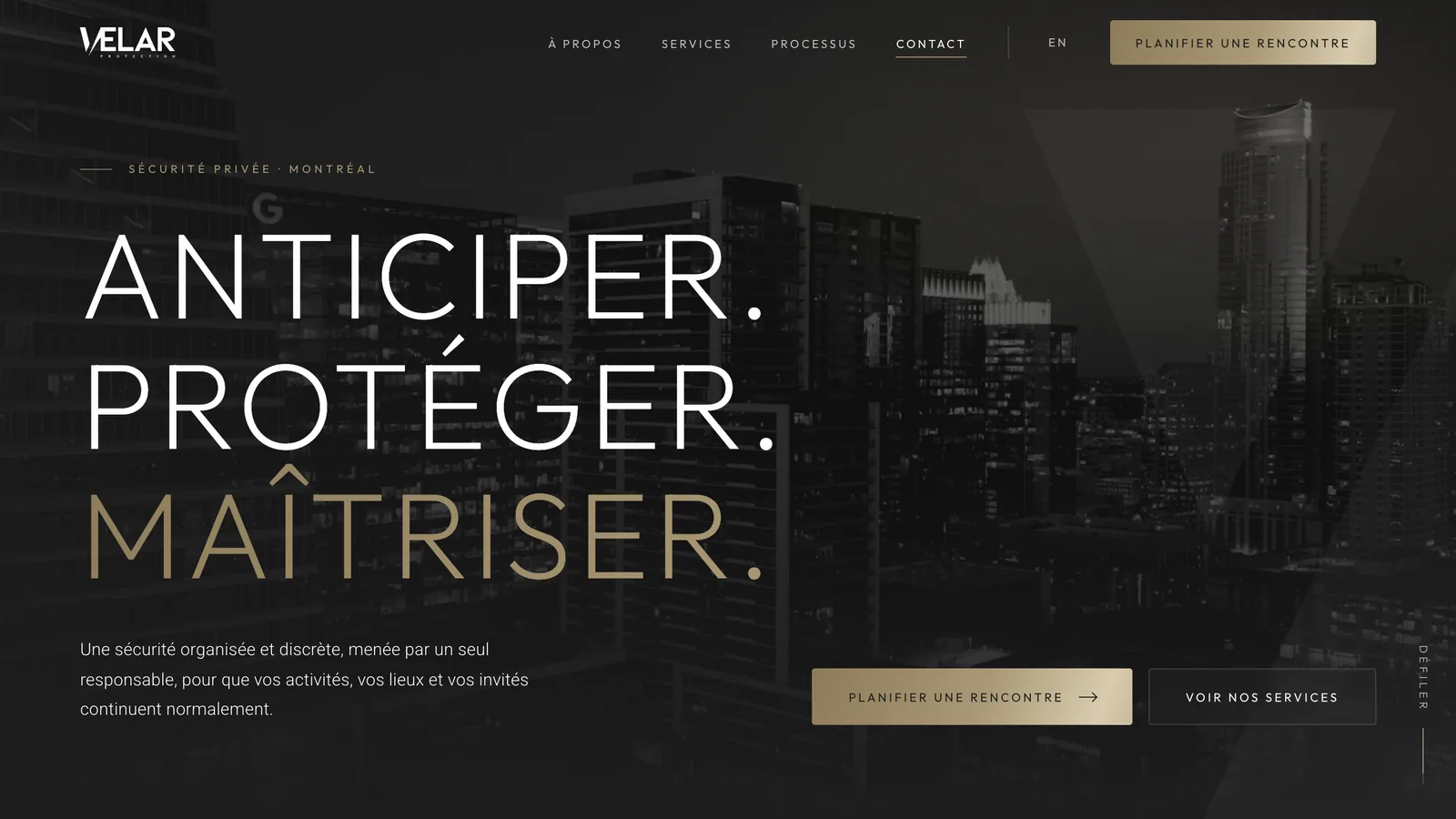
A premium service business website: what builds trust?
Trust begins before the door handle. What builds it online.
3 min read
About a 5-minute read
A premium service business doesn’t sell an object; it sells a promise. Its website builds trust when it does five things: a careful first impression, an offer that’s clear in seconds, concrete proof, a simple enquiry and a fast reply. Clients often decide before they even call.
Luxury real estate, aesthetic clinics, concierge services, private security: these trades are judged on trust, and trust begins online. This guide covers what works. For the design itself, see our custom websites page.
1. The first impression does the first sort
A high-end client compares two or three businesses, often on a phone. An approximate image, a slow page or a typo in the first paragraph is enough to rule you out. A calm, fast, careful site, on the other hand, already says: here, details matter.
Velar Protection, a private security company in Montreal, is one example. Its site speaks first through three verbs, anticipate, protect, control, and restrained colours, black and gold, rather than flashing lights. The tone reassures before the first line of text.
2. Say in seconds what you do, and for whom
Visitors should grasp three things without scrolling: what you offer, to whom, and where. A clear sentence beats an empty slogan. Services then come one by one, with what each changes for the client.
3. Show proof, not promises
| Proof | What it brings |
|---|---|
| Named, approved testimonials | A real voice that commits |
| Examples of mandates, described discreetly | A demonstration of expertise |
| Certifications, permits, professional orders | Legitimacy, where the trade requires it |
| Published response times | A measurable commitment |
| Local presence | An address, a territory, a language |
In a discreet trade, proof can be shown without betraying anyone: an industry, a type of mandate, a result as a percentage rather than a name or an amount.
4. An identity that looks like the service
An agency that sells image has to take care of its own first. Générationnel, a hospitality, luxury and lifestyle marketing agency, understood this from launch: a manifesto rather than a list of services, images set into the text, two languages from day one. The site becomes the first proof of what it can do for its clients.
5. An enquiry that respects the client’s time
A few well-chosen questions: the need, the timeline, the best way to reply. A confirmation page that says what happens next. And a fast reply, because a high-end client doesn’t wait. For some trades, online booking replaces the form.
6. Follow-up, the invisible part
The site doesn’t end at the enquiry. A well-crafted confirmation email, a personal reply, a reminder before the appointment: these gestures extend the impression the site made, or contradict it.
FAQ
Should prices be shown? Not necessarily. At the high end, a first call followed by a tailored proposal often reassures more than a posted rate.
How many pages are needed? Fewer than you’d think: a page per key service, a page about the company, proof, and a simple contact.
Does the site need to be bilingual? In Quebec, a French version is required; English often widens a high-end clientele.
A question about your project? Let’s talk it through. Write to us